


theory & concepts

What Bees and Trees Must Be Allowed to Do: On the Rights of Urban Nature
Wojciech Czaja, Architecture Journalist, Vienna/Berlin Katja Schechtner, Urban Planner and Researcher, MIT Boston Alex Putzer, Philosopher of Nature and Law, TU Delft zoom lecture, questions and discussion Tuesday, November 10, 2026, 17.00 hrs The biodiversity of New...

Growing Food in the Heart of the City: PAKT and Volle Grond – a Greener and Edible City from the Rooftops
What could the cities of the future look like? In Antwerp, Belgium, PAKT and Volle Grond are exploring how rooftops can become productive, living spaces that bring food production, nature and people together. What began in 2016 as an experiment in urban agriculture...

Evaluation after 5 Years: Biotope City Wienerberg – Concept, Objectives, Results
Five years after its completion, Biotope City Wienerberg is being evaluated. A detailed resident survey and a review by the key experts involved—the IBA Vienna 2022 pilot project has passed the test, a result that is quite impressive.

Who WillPay for It?
by DI Doris Schnepf and Mag. Roland Honeder The topic is the eco-social urban renewal bond – an innovative financial and organizational instrument for promoting urban biodiversity and climate-resilient city districts, using the examples of the Klimaboulevard Melk and...

5 YEARS of BOSCO VERTICALE IN SOCIAL HOUSING
Now available on the BIOTOPE CITY JOURNAL YouTube channel: https://www.youtube.com/watch?v=JYpICcfOA98 https://www.youtube.com/results?search_query=biotope+city+journal The Trudo Tower in Eindhoven has been in operation for 5 years: an occasion for an evaluation...

Vegetation’s Impact on Climate
webinar by Dipl.-Met. Guido W. Halbig https://www.youtube.com/@biotopecityjournal For the 50th lecture in our series, we are pleased to announce a webinar featuring a fundamentally important presentation: Dipl.-Met. Guido Halbig will highlight climate influences that...

Experiences with Nature-Inclusive Building
ir. Maike van Stiphout, landscape architect, Amsterdam https://www.youtube.com/@biotopecityjournal The temperature-reducing effects of greening in urban spaces are, fortunately, now widely known. But what does "greening" actually mean? Chlorophyll isn't a...

Greywater Use – Potentials in and Around Buildings
Webinar with Oliver Pongracz and Susanne Formanek Now available on our YouTube channel: Greywater Use – Potentials in/on and around Buildings In densely built cities, water is becoming an increasingly precious resource. At the same time, a large amount of...

Urban Expansion in Munich: The Role of Cooperatives for Social Cohesion under the Guidelines ‘Sustainability and Ecology’
Dipl.Ing. Wolfgang Heidenreich Wolfgang Heidenreich examines the influence of activities by young housing cooperatives on new Munich urban districts, through which the implementation of the goals 'ecology/biodiversity' and 'climate protection' in the areas of...
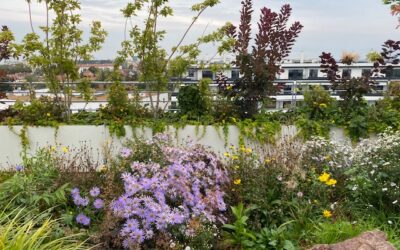
The example of Biotope City Wienerberg: The green city at the crossroad of disciplines, investors and authorities
Contribution to the Conference of the Deutscher Werkbund Berlin on 'New Social Housing', May 2022 As architects and urban planners we design and build products that should still fulfil their function for at least 100 years. Of course, we cannot give an idea of the...

Space for Nature in the City
Webinar by Conrad Amber Now at the Youtube Channel of BIOTOPE CITY JOURNAL click on 'video' - MPORTANT: At the end of the English announcement, you'll find instructions to activate YouTube's AUTO TRANSLATION for the video There is room for nature everywhere. Whether...

Edible Balcony Gardens With Rainwater Integration in Retrofit
Dr. DI Irene Zluwa and DI Dr. Philipp Spörl GRÜNSTATTGRAU Innovations- und Forschungs-GmbH and University of Natural Resources and Life Sciences Vienna, Institute of Engineering Biology and Landscaping Irene Zluwa (GRÜNSTATTGRAU) and Philipp Spörl (BOKU University)...

A walk through the garden paradise Nuthe Siedlung in Potsdam
Photos: Helga Fassbinder The social housing estate was designed and built between 1999 and 2002 by Hinrich Baller, architect in Berlin and emeritus professor at the Academy of Arts Hamburg (HfbK). The Nuthe Estate in Potsdam has to be considered as Hinrich Baller's...

Obituary for Hinrich Baller
The news of the death of Hinrich Baller, one of the great architects of the past century, reached us with a delay. He was one of the few in the architectural world who devoted himself to the topic of integrating greenery into buildings from the very beginning of...

The Biotope City Concept
The Biotope City concept - the dense city as nature - was developed from the realization of fundamental changes in the framework conditions of architecture and urban development due to climate change, global population expansion and rapid urbanization, loss of...

Biodiversity in the City – Experiences With Planting Tree Beds
on the Youtube Channel of Biotope City Journal : https://www.youtube.com/@biotopecityjournal8524 WEBINAR by DI Andrea Mann, architect and DI Sarah Prehsler, landscape planner The greening of residual areas in the city is a current topic in climate protection and...

Between Concrete and Flowers – Wild Bees and Wasps in the City
https://www.youtube.com/watch?v=JQr6BYWGk90&t=11s Zoom webinar with Dr. Dominique Zimmermann, Natural History Museum Vienna The much-lauded greenery in the fight against urban heating does not come alone: there is no flora without fauna - and that includes...

A Plan B for the Climate – Overcoming Climate Change With the Forces of Nature
em.Prof. Dr. Gerd Ganteför, University of Konstanz Lecture on the Youtube Channel of Biotope City Journal: https://www.youtube.com/watch?v=3u73xWdNBNw Man-made climate change is real, it is due to the increasing concentration of CO2 in the atmosphere, which is mainly...

Urban Development Program for the Green City of the Future : Zaandam
by architect Mathias Lehner, MSc Mathias Lehner reports on his work on the 2040-2050 urban development plan for Zaanstad, a neighboring city of Amsterdam with 160,000 inhabitants that is set to grow rapidly to 200,000. This spatial vision for the future, entitled...

The Healing Garden Hamburg – Nature Cyclical Impulses for the Urban World
The rapid urbanization and digitalization of our living environments increasingly alienates us from nature, thereby impairing our physical, mental, and emotional well-being. The association “heilende Stadt e.V.” is establishing a model project called the Healing Garden Hamburg in the Altona People’s Park, focusing on nurturing the relationship between nature and humans – as a physical-sensory experience, ‘holistic’ (from the Greek ‘holos’ = whole) with a new “nature cyclical” mindset.

Renaturation in the City
DI Wolfgang Suske, University of Natural Resources and Life Sciences, Vienna The Restoration Act obliges EU member states to take measures to restore destroyed ecosystems. At least 20% of the EU's land and sea areas are to be restored by 2030, with the aim of...

Green Pre-Shading of Glass Facades – Preliminary Findings From the GLASGrün Project
Webinar Tuesday, December 17, 2024, 17.00 hrs Prof. DI Dr. Rosemarie Stangl, University of Natural Resources and Life Sciences Vienna, Institute of Engineering Biology and Landscaping https://www.youtube.com/watch?v=Z5ithJ17o1M We now know how important the greening...

The production of the future: urban planning in civil society
Preliminary remark: This text was written in 1995 and published in 1997 in the anthology ‚Zivile Gesellschaft‘ (Civil Society) edited by Schmals/Heinelt. Reading this text now, nearly 30 years later, I am amazed at how accurately the necessity of the urban development...

Existing Buildings as a Resource – the Green Bunker in St. Pauli, Hamburg
Tuesday, december 3, 2024, 17.00 hrs webinar for free by Dipl.Ing. Marco Schmidt, TU Berlin This huge concrete structure from the Second World War has been transformed into a green Bunker with a 560- meter green mountain path and a 1,400 m2 garden at the top, as well...

Wiener Wäldchen” – About the Application of the Tiny Forest Concept in Vienna
Webinar by Florian Schmid, City of Vienna on the youtube channel of Biotope City Journal Mini-forests, forest islands or so-called 'Tiny Forests' are currently on everyone's lips. A few years ago, Vienna also began to explore the principles of the Miyawaki method for...

Antennas into the future from science, philosophy and art
Is there a fundamental flaw in our Western thinking that has led us into the current complex crisis of climate change, loss of biodiversity and scarcity of resources? What can we do, what must we do to come to terms with nature and its great, overarching cycles in a densely populated world? Because this is entirely possible if we make a number of adjustments to our living conditions… including for urban life: the dense city can become nature, in whose great, overarching context we integrate: the city as a biotope, Biotope City.

Climate Change and Target-Oriented Adaptation Measures
Prof. Helga Kromp-Kolb, University of Natural Resources and Life Sciences, Vienna Now available on our YouTube channel: Climate Change and Target-Oriented Measures If you subscribe to the YOUTUBE CHANNEL BIOTOPE-CITY JOURNAL, you won't miss anything, and you will be...

Light Pollution – the Dark Side of Artificial Outdoor Lighting
Lecture and webinar by DI Ramona Cech BSc, Vienna Environmental Ombudsman's Office Artificial lighting has enabled mankind to extend the period of activity, increase productivity and the feeling of safety - LED technology has made lighting more cost-effective than...

THE LOWLINE AIMS HIGH
Photo on top: The current abandoned Williamsburg Trolley Terminal space Click on images to enlarge them. They will appear in a new tab. After years of planning, another ambitious project rivaling the Highline in all its aspects, both good and bad – is being realized...
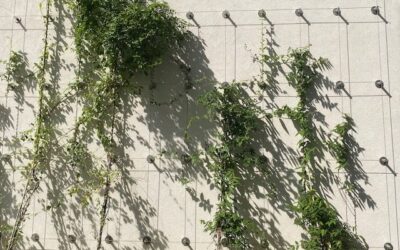
Building Greening and Fire Protection
An important topic! The City of Vienna recently introduced new subsidy regulations for the greening and unsealing of buildings - they are exemplary and will certainly lead to a surge in greening, especially in private buildings. And hopefully also provide an impetus...

More Money – More Green: Vienna’s New Funding Guidelines
Lecture by Jürgen Preiss, City of Vienna Now on the YouTube Chanal of BIOTOPE CITY JOURNAL https://www.youtube.com/watch?v=Y26cEdhyFcc&t=292s The Vienna City Council recently passed new subsidy guidelines for greening and unsealing buildings, which make it easier...
The production of the future: urban planning in civil society
This text was published in 1997 in the anthology ‘Zivile Gesellschaft’ (Civil Society) edited by Schmals/Heinelt. 25 years later, it is amazing how accurately the necessity of the urban development strategies outlined for solving urban problems were described back then – and at the same time it is shocking how little of the outlined solution strategies, having lost none of their validity, have penetrated into the reality of society and its planning. Yet such a form of planning would be more necessary than ever in order to put a stop to the problems of nature destruction with its biodiversity and climate change on the one hand and the increasing lack of natural resources and space on the other. It is worth reading!
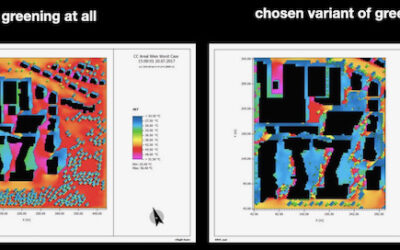
Differentiated Cost-Benefit Analysis of the Effects of Urban Greenery
Which of the green-blue infrastructures, green roofs or façades, or perhaps trees, are the most effective means of climate adaptation, especially against the increasing overheating of our cities? Given the costs involved, which solution is the best choice?

On a Necessary Paradigm Shift From the CO2 Narrative to Water, Vegetation and Soil
Tuesday, May 28, 2024, 17.00 hrs - Webinar with Dr. Marco Schmidt, TU Berlin Climate change, rapid global urbanization, agricultural monocultures, the dramatic decline in biodiversity - these are all complex, mutually dependent processes. Dr. Marco Schmidt says: "The...
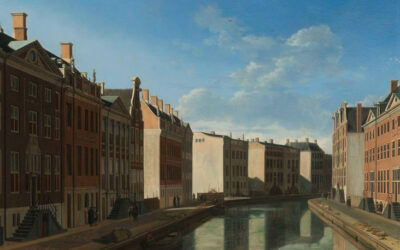
Regarder vers l’avenir – tirer les leçons du passé
Amsterdam 1671-1672 La 'baie d'or' du Herengracht. Peinture de Gerrit Adriaensz. Berckheyde, Gemeente Museum Amsterdam Le développement d'Amsterdam au 17e siècle comme paradigme de l'urbanisme bleu-vert et un exemple réussi à Vienne aujourd'hui Rien ne semble plus...
Looking back to the future – learning from the past
Amsterdam 1671-1672 The 'Golden Bay' of the Herengracht. Painting by Gerrit Adriaensz. Berckheyde, Rijksmuseum Amsterdam On the development of Amsterdam in the 17th century as a paradigm of blue-green urban planning and on a successful example in today's Vienna...
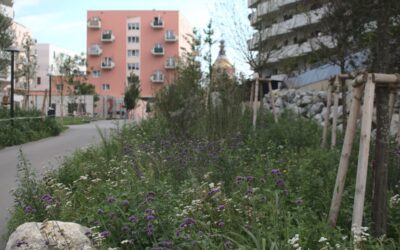
Towards an URBAN FUTURE: BIOTOPE CITY
Building the city of the future – a common saying. But what is really happening? Do we realise what the requirements of the future will be? Cities and city districts have to be built with a time horizon of centuries. We have to build the city of the future TODAY. But what does the future look like that we have to build for? What are its demands?
Vers l’AVENIR URBAIN: BIOTOPE CITY
La biodiversité menacée et l’expansion croisante des villem- quoi faire? Considérer la ville elle-même comme une forme de nature et donner de l’espace à la nature sous ses diverses formes dans l’environnement construit. C’est ‘voir la ville comme un biotope’, Biotope City. Conclure un contrat social avec la nature !

The Invasion of Nature into the City
Integrating biodiverse nature into urban areas: What is possible? What is desirable? How does one do it? Does it even make sense? Rules of the game for citizens and professionals in planning, design and maintenance. Prof.Dr. Helga Fassbinder, Foundation Biotope City...
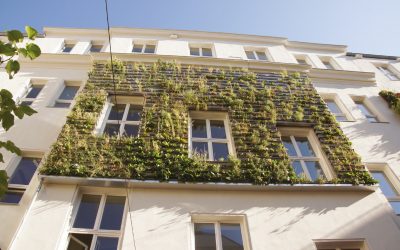
Fire protection with facade greening
Dr. Dieter Werner, Testing, Inspection and Certification Body of the City of Vienna, Head of the Building Physics Laboratory Is facade greening a fire hazard? The City of Vienna has been investigating the fire behavior of facade greening since 2015. In the meantime,...

Rooftop Community Gardens – an extraordinary case at Vienna
Webinar by Margarete Eller The "Gartenwerkstatt" is Europe's largest community rooftop garden. It is located on the roof of a municipal high-rise garage and has about 50 members who have organized themselves as an association. It is a project worth emulating for...

Birds crashing into buildings: The invisible death and how it can be prevented
Lecture by Bendedikt Heger, 13.6., 17 h Every year, hundreds of thousands of birds die in collisions with glass panes in Austria alone. B.Sc, M.sc. Benedikt Heger from the Vienna Environmental Advocacy's Office explains why this is so, where the danger is particularly...
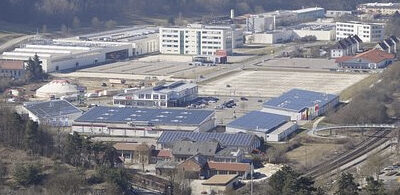
Urban industrial areas as ecological potential
by dr. ir. Robbert Snep, Wageningen University & Research, Netherlands On the youtube canal of BIOTOPE CITY JOURNAL : https://www.youtube.com/@biotopecityjournal8524 At a rapid pace, we are still sealing huge areas of land every day - in Austria, this amounted to...

Current findings of the Intergovernmental Panel on Climate Change
Lecture by Dr. Guido Halbig, IPCC and Deutscher Wetterdienst It gets hotter and drier in the cities - often in summer hardly bearable. At the same time, localized, extreme precipitation is increasing. Do we definitely have to prepare ourselves for this fact? As the...
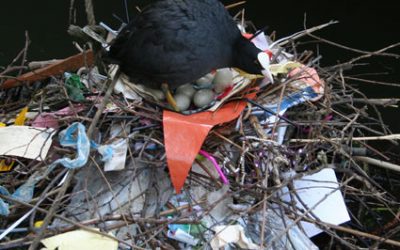
Wildlife in The City
The green toad, the field hamster and the alpine bat, many species live next to us in the city. One man's joy, another man's sorrow? How and why is a rich nature in the city so important on a small and large scale? What opportunities are there for people to...
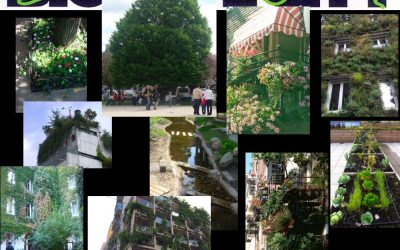
Greening the city – the utopian reality ?
Interview with Helga Fassbinder, emeritus professor at University of Technology and University of Technology Hamburg about the concept of Biotope City and its realization in Vienna, Austria
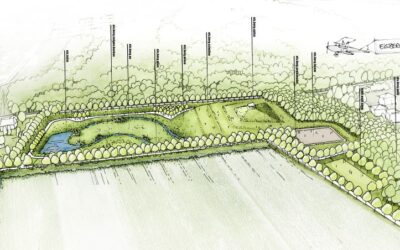
Green infrastructure as an integrative constituent and prerequisite of urban development
Is there a way to design and implement a customised green infrastructure for new settlement expansions? This article shows how a multifunctional and interdisciplinary planning approach can be used to develop a new settlement area in the city of St.Pölten called “Eisberg” despite climate change.
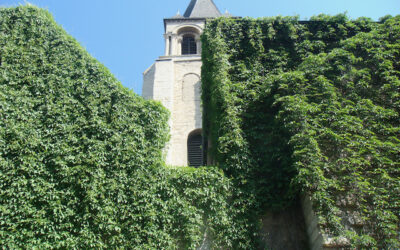
Greening Facades – A Historical Introduction
Greening buildings has a long tradition and has been practiced for thousands of years: it has many advantages – not only aesthetically, but also in terms of its effects on the environment and health. Recently, it has experienced a revival due to climate change.

CLIMATE CHANGE and GENDER
The lecture is now online on our youtube channel ! https://www.youtube.com/watch?v=QxCE5njoksg The effects of climate change are not felt equally by everyone. Women, and particularly women from the Global South, are disproportionately affected by climate change and...

Sociocratic Neighbourhood Circles SoNeC
SoNeC is a 26 month-long Erasmus+ project including Biotope City. It is funded by the EU’s “KA2 Strategic Partnerships for adult education” program and addresses serious social and environmental issues by applying neighborhood-based, bottom-up, participatory and inclusive decision making processes.
Interested to use the concept
or to be a part?
You are welcome to send contributions and do not hesitate to get in contact with us !